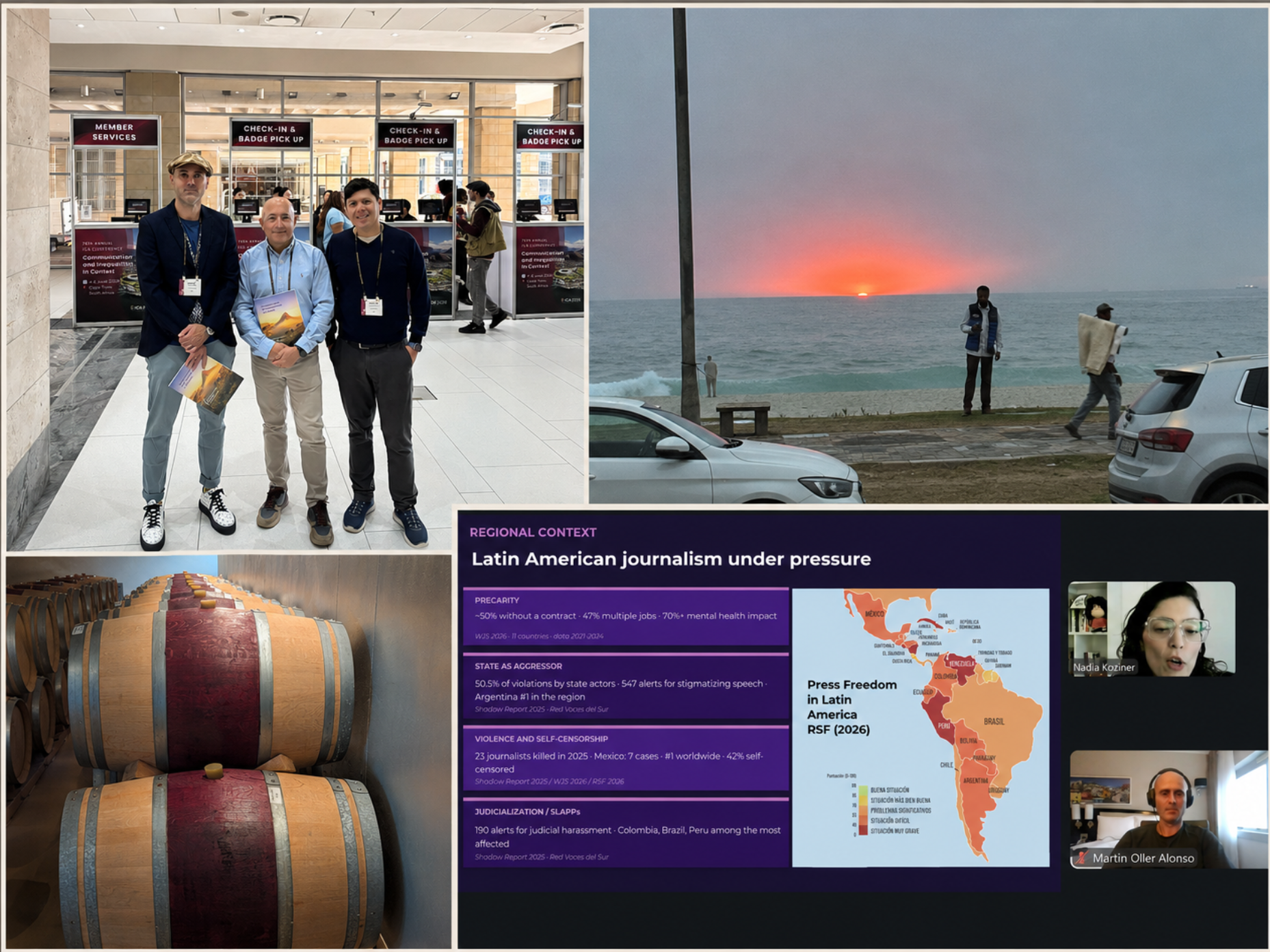
In addition to the main ICA conference, I also participated in the virtual ICA Pre-Conference “Media and Communication in Global Latinidades,” held on June 3, 2026. This pre-conference created a valuable space for discussing journalism, communication, identity, inequality, platforms, political conflict, and professional cultures across Latin American and Latinidad contexts.

My presentation was included in Panel 1: Journalism Cultures, Practices, and Professional Identity, chaired by Pablo Porten-Cheé from Heidelberg University. The panel brought together comparative and regional perspectives on journalism, professional identity, working conditions, audience transformations, and the shifting boundaries of the profession.

I presented the paper “¿Quién es quién en el periodismo ecuatoriano? Definiciones y fronteras entre periodistas ‘profesionales’ y ‘periféricos’”, also developed in English as “Who Counts as a Journalist in Ecuador? Professional and Peripheral Journalists in a Majority World Media System.”
This work addresses one of the central conceptual and methodological questions in journalism studies: who counts as a journalist? The question is not merely technical. It determines visibility, legitimacy, comparability, and recognition in comparative journalism research. Sampling criteria determine which actors enter the data, which forms of journalism become measurable, and which practices remain empirically marginal despite their social relevance.
The Ecuadorian case is especially significant because it shows how definitional decisions have material consequences in Majority World media systems. Ecuadorian journalism operates in a context marked by political instability, precarious labour conditions, institutional fragility, harassment, violence, self-censorship, and weak protection for journalists. In such contexts, being recognised as a journalist can affect access to institutional support, public legitimacy, professional protection, and visibility in international research.
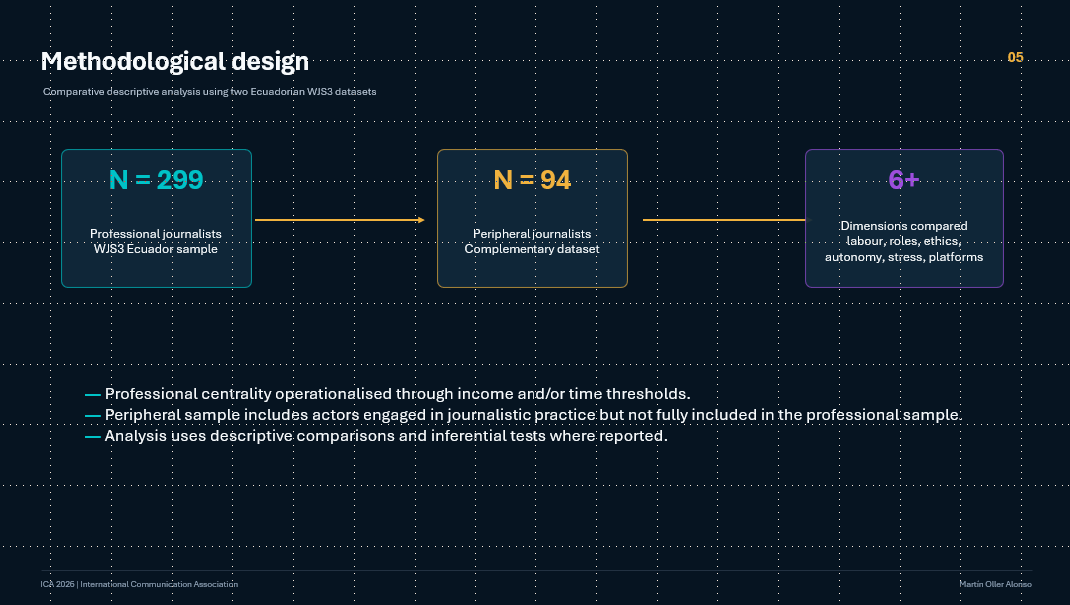
The study draws on two Ecuadorian datasets from the third wave of the Worlds of Journalism Study. The first includes 299 professional journalists from the WJS3 Ecuador sample. The second includes 94 peripheral journalists, understood as actors engaged in journalistic practice but not fully included in the professional sample under conventional income, time, or occupational centrality criteria.
The paper compares both groups across several dimensions: labour conditions, professional training, journalistic roles, ethical orientations, editorial autonomy, work-related stress, and media/platform distribution. The aim is not to dissolve all distinctions between professional and peripheral journalism, but to examine whether the boundary between them should be understood as a rigid divide or as a continuum of journalistic belonging.
The findings suggest that peripherality in Ecuador is occupationally real but not culturally external to journalism. Professional journalists are more likely to hold full-time permanent positions and report more years of journalistic experience. They also report higher editorial autonomy, but also greater work-related stress. Peripheral journalists, by contrast, occupy less institutionally stabilised positions, but they share many core public-service commitments with professional journalists.
One of the most important findings is that peripheral journalists are not significantly less trained than professional journalists. The differences in formal journalism education and higher education are comparatively small. This challenges simplistic interpretations of peripheral journalism as amateur, untrained, or external to professional knowledge.
The strongest distinction appears in ethical orientation. Professional journalists are more strongly attached to universal professional standards, while peripheral journalists are more open to situational and personal judgment-based ethical reasoning. This does not imply ethical weakness. Rather, it suggests that formal ethical codification is one mechanism through which institutional integration operates.
The study also indicates that peripherality is not simply “more digital.” Professional journalists are more connected to television and print media, while peripheral journalists are more active in radio and podcasting. This indicates a differentiated media ecology in which professional and peripheral actors occupy distinct but overlapping spaces of journalistic practice.
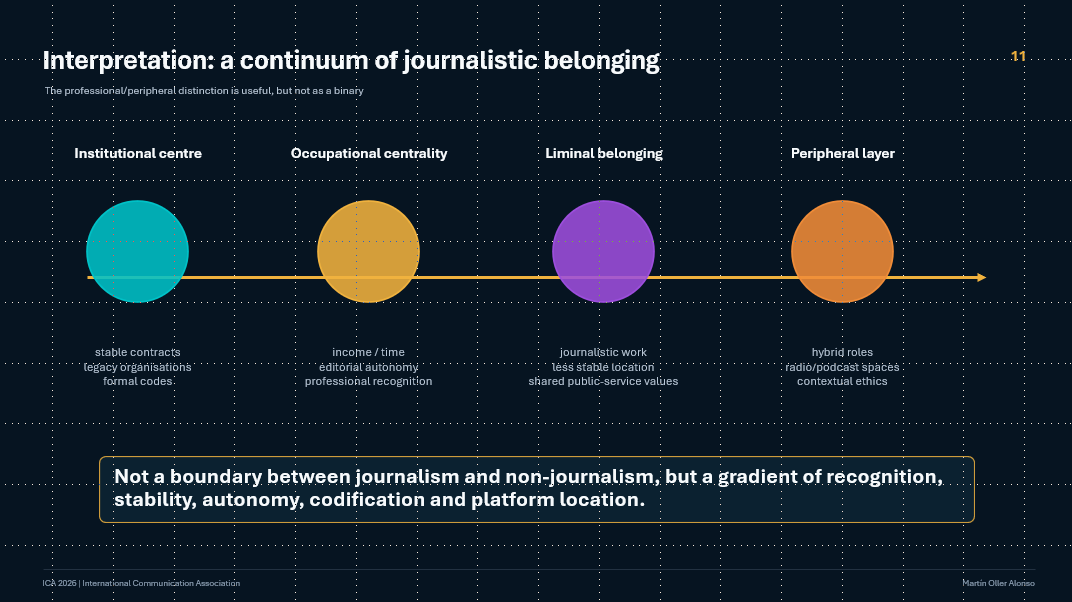
The central conclusion is that Ecuadorian peripheral journalists are not outside of journalism. They occupy a liminal position within it: less institutionally stabilised, less occupationally central, but often aligned with core public-service values and journalistic functions. The distinction between professional and peripheral journalism is therefore useful, but not as a binary boundary. It should be understood as a gradient of recognition, stability, autonomy, codification, and platform location.
This has important implications for future comparative journalism research, including the Worlds of Journalism Study. Rather than asking only “who counts?”, comparative research should ask: what dimension of journalistic belonging are we measuring, for what purpose, and with what consequences?
The Ecuadorian case points toward layered, purpose-driven, and context-sensitive sampling designs: a strict professional core for comparability, a documented peripheral layer for contextual richness, and transparent boundary variables that make inclusion and exclusion decisions explicit.

 MARTÍN OLLER ALONSO
Deja un comentario