Event: 2026 Worlds of Journalism Study Meeting
Dates: 9–10 June 2026
Venue: Stellenbosch Institute for Advanced Study (STIAS), Stellenbosch, South Africa
Context: WJS3 lessons, WJS4 discussion, works-in-progress presentations, collaborative publication workshop, and planning for future WJS meetings.
Presentations
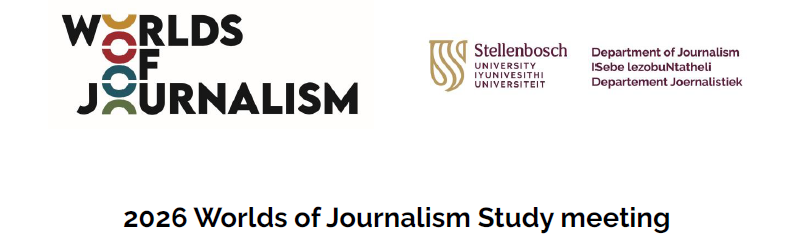
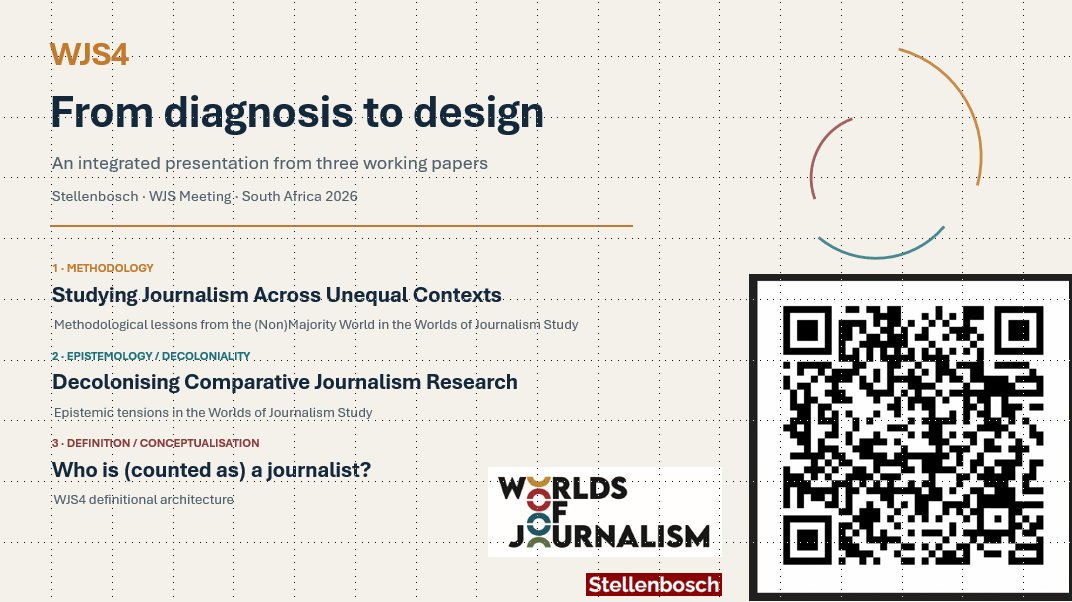
[1] Studying Journalism Across Unequal Contexts: Methodological Lessons from the Majority World in the Worlds of Journalism Study
[2] Decolonising Comparative Journalism Research: Epistemic Tensions in the Worlds of Journalism Study
[3] Who Counts as a Journalist? Definitional Architecture, Sampling Boundaries, and Design Lessons for WJS4
In June 2026, I participated in the 2026 Worlds of Journalism Study Meeting, held on 9–10 June at the Stellenbosch Institute for Advanced Study (STIAS) in Stellenbosch, South Africa. The meeting brought together members of the Worlds of Journalism Study consortium to discuss the lessons learned from WJS3 and to define key directions for WJS4.
The event was especially relevant because it was not only a space for presenting works in progress, but also a collective moment of methodological, conceptual, and epistemological reflection. The central question was how the next wave of the Worlds of Journalism Study can maintain global comparability while better accounting for unequal research contexts, Majority World conditions, shifting professional boundaries, and forms of journalism that remain empirically marginal but socially central.
Within this framework, I contributed to three interconnected working papers and presentations focused on the future design of WJS4:
1. Studying Journalism Across Unequal Contexts: Methodological Lessons from the Majority World in the Worlds of Journalism Study
2. Decolonising Comparative Journalism Research: Epistemic Tensions in the Worlds of Journalism Study
3. Who Counts as a Journalist? Definitional Architecture, Sampling Boundaries, and Design Lessons for WJS4
Together, these three presentations formed an integrated argument: comparative journalism research does not simply observe journalism across the world. It also produces the categories, samples, boundaries, and evidence through which journalism becomes globally measurable.
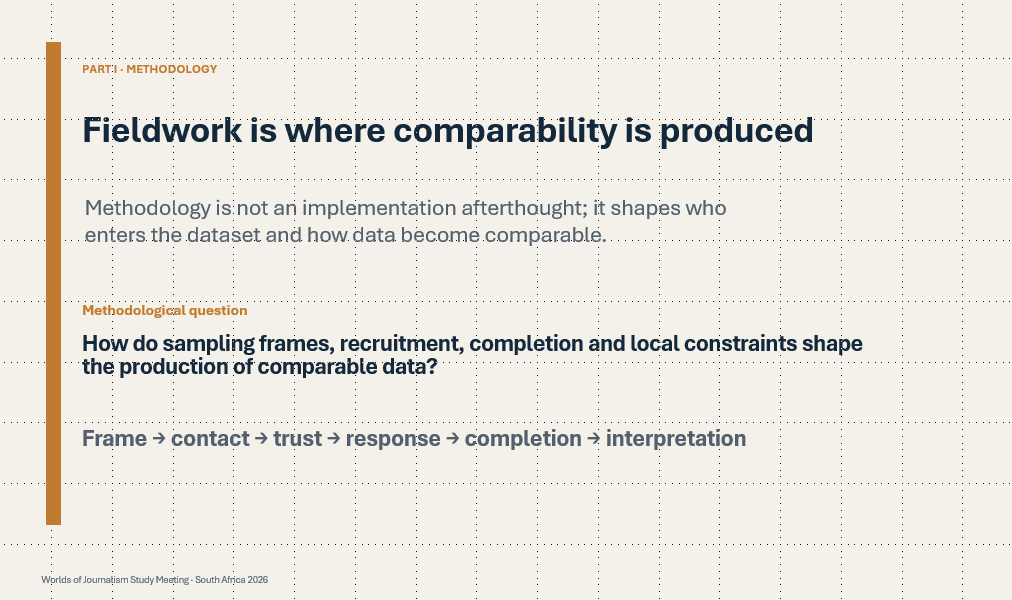
The first presentation, “Studying Journalism Across Unequal Contexts,” focused on methodology. It argued that fieldwork is not a secondary implementation issue, but the place where comparability is actually produced. Sampling frames, respondent access, completion rates, eligibility criteria, institutional resources, and local constraints shape who enters the dataset and how comparable the data become.
Based on the WJS Reflexive Questionnaire and qualitative evidence from country teams, the presentation showed that methodological difficulty is unevenly distributed. Majority World teams reported higher fieldwork pressure, stronger epistemic friction, and greater conceptual-boundary difficulty. This finding matters because it indicates that methodological problems are not merely technical. They are linked to unequal infrastructures, fragile directories, lack of reliable journalist censuses, low response rates, institutional distrust, and limited resources.
The core methodological proposal was clear: WJS4 should not adopt weaker standardisation, but more documented standardisation. This means preserving the shared comparative core while adding formal protocols for sampling diagnostics, boundary-case logs, contextual adaptation notes, safety and ethics guidance, recruitment and trust protocols, and post-fieldwork reporting.
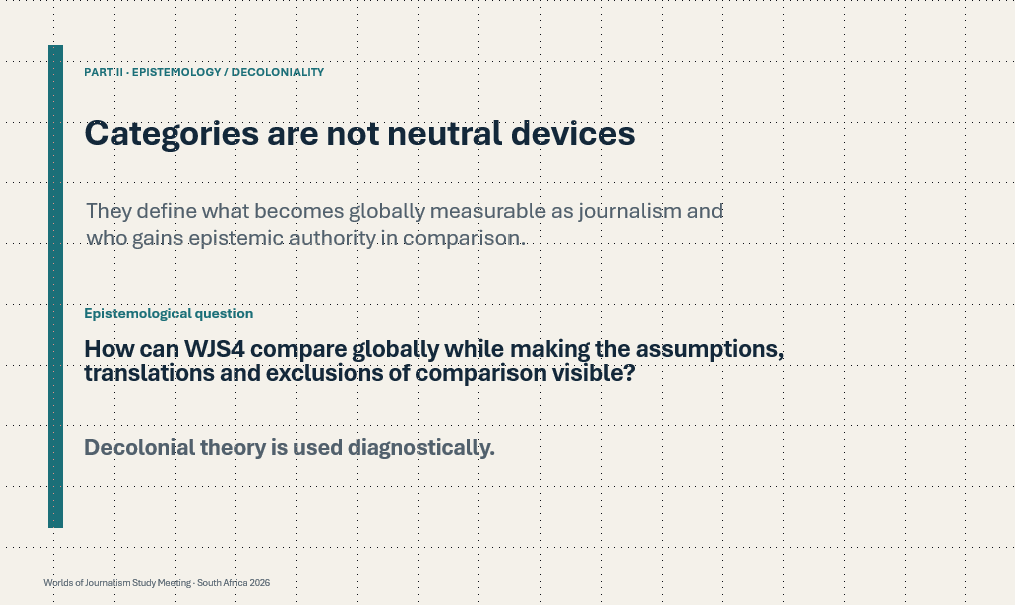
The second presentation, “Decolonising Comparative Journalism Research: Epistemic Tensions in the Worlds of Journalism Study,” addressed the epistemological dimension of comparison. Its central claim was that categories are not neutral devices. They define who and what becomes globally measurable as journalism.
The presentation distinguished between de-Westernisation and decolonisation. De-Westernisation expands geographical and intellectual inclusion; decolonisation interrogates the architecture through which inclusion becomes measurable, legitimate, and comparable. For WJS4, the question is not only whether more countries and voices are included, but also who helps define the categories through which journalism is measured.
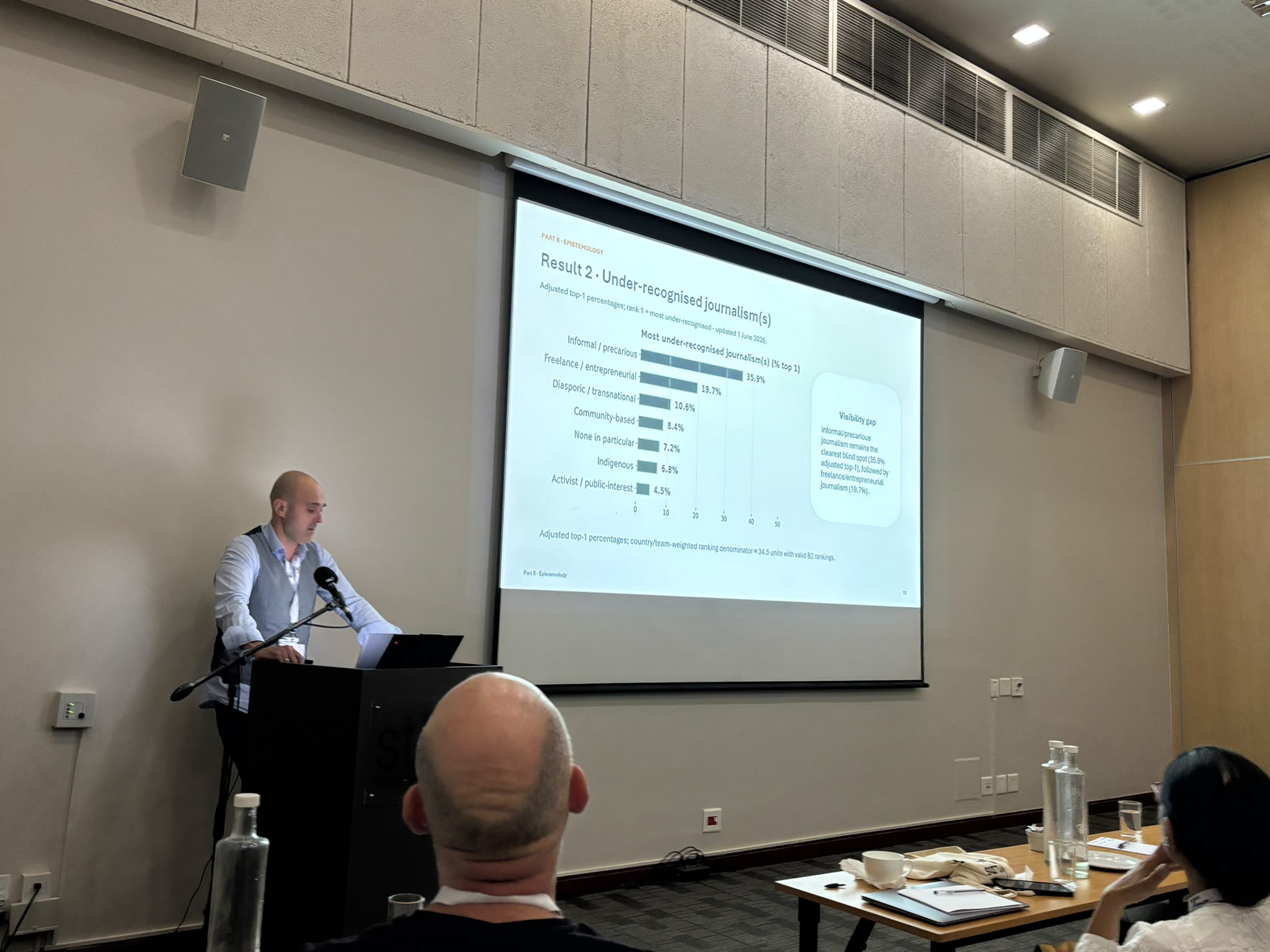
The analysis showed that WJS categories travelled unevenly across media systems, labour markets, political contexts, linguistic traditions, and knowledge ecologies. Some forms of journalism remain under-recognised, particularly informal, precarious, freelance, entrepreneurial, community-based, diasporic, Indigenous, platform-native, and hybrid journalism. The main blind spot is therefore not only “non-Western” journalism, but weakly institutionalised journalism.
The proposed solution was not to abandon comparison, but to make comparison more accountable. The presentation suggested a tiered WJS4 architecture based on a stable global core, regionally negotiated modules, reflexive metadata files, category-travel protocols, translation-as-negotiation notes, and decision trees for borderline cases. In this sense, decolonial comparison was presented as transparent standardisation, not relativism.
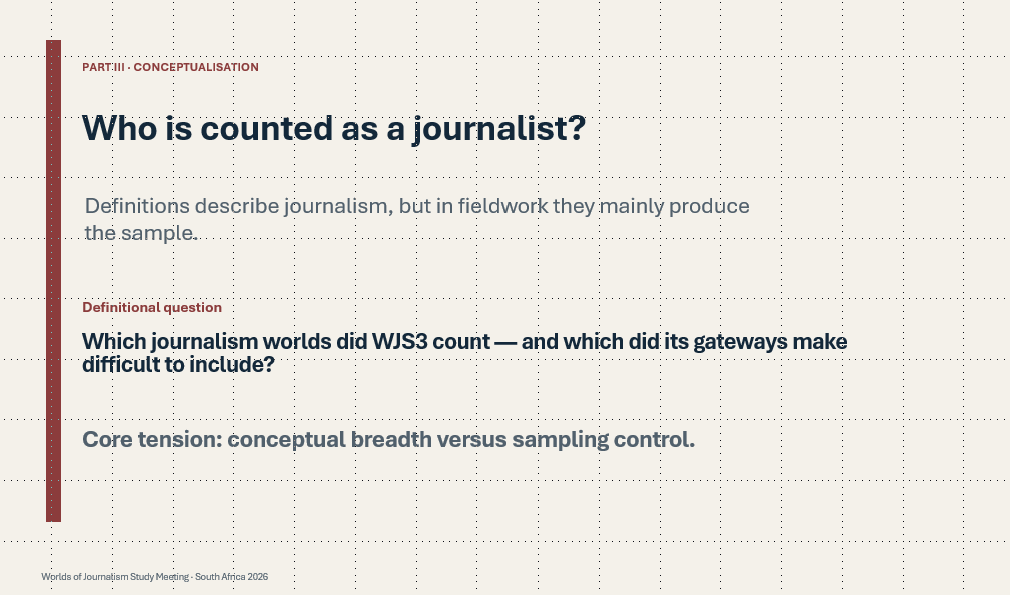
The third presentation, “Who Counts as a Journalist? Definitional Architecture, Sampling Boundaries, and Design Lessons for WJS4,” focused on the definitional problem. Its starting point was that definitions do not only describe journalism; in fieldwork, they mainly produce the sample.
This presentation argued that WJS3 exposed a central design tension: one definition was asked to do too much. Conceptual definition, fieldwork eligibility, longitudinal continuity, organisational recognition, practical sampling, and professional legitimacy were compressed into the same boundary. As a result, the final gateways relied heavily on visible organisational markers, especially formal employment, organisational affiliation, income, and working time devoted to journalism.
The presentation showed that this approach creates visibility bias. Actors with formal organisational markers are easier to identify and include, while precarious, freelance, informal, community-based, peripheral, hybrid, or platform-native actors may be undercounted precisely in contexts where insecurity and vulnerability are high.
The proposed WJS4 solution was a layered sampling architecture. Rather than treating the professional/peripheral distinction as a rigid binary, the presentation suggested controlled and documentable gateways: professional core, freelance/entrepreneurial journalism, community/peripheral journalism, and platform-native/hybrid journalism.
The aim is not unlimited inclusion. The aim is to make ambiguity traceable, comparable, and analytically usable. Each country team should document why a respondent was included, excluded, or classified differently; what evidence supported the decision; and what trade-off was involved between precision, inclusivity, continuity, and contextual validity.
The three presentations converged in a single proposition: WJS4 will be stronger if it studies many worlds of journalism while making explicit how those worlds are counted, sampled, translated, and interpreted.
This integrated contribution proposed four core design principles for WJS4:
First, preserve the stable global core. Cross-national and longitudinal comparison remains essential.
Second, document the boundary. Difficult cases should not be hidden inside the final sample; they should become part of the methodological evidence.
Third, make categories accountable. Translation, adaptation, exclusion, and local interpretation should be recorded as part of the research process.
Fourth, support country teams. Unequal research contexts require methodological infrastructure, training, collaborative support, and clearer protocols for sampling, fieldwork, analysis, and publication.
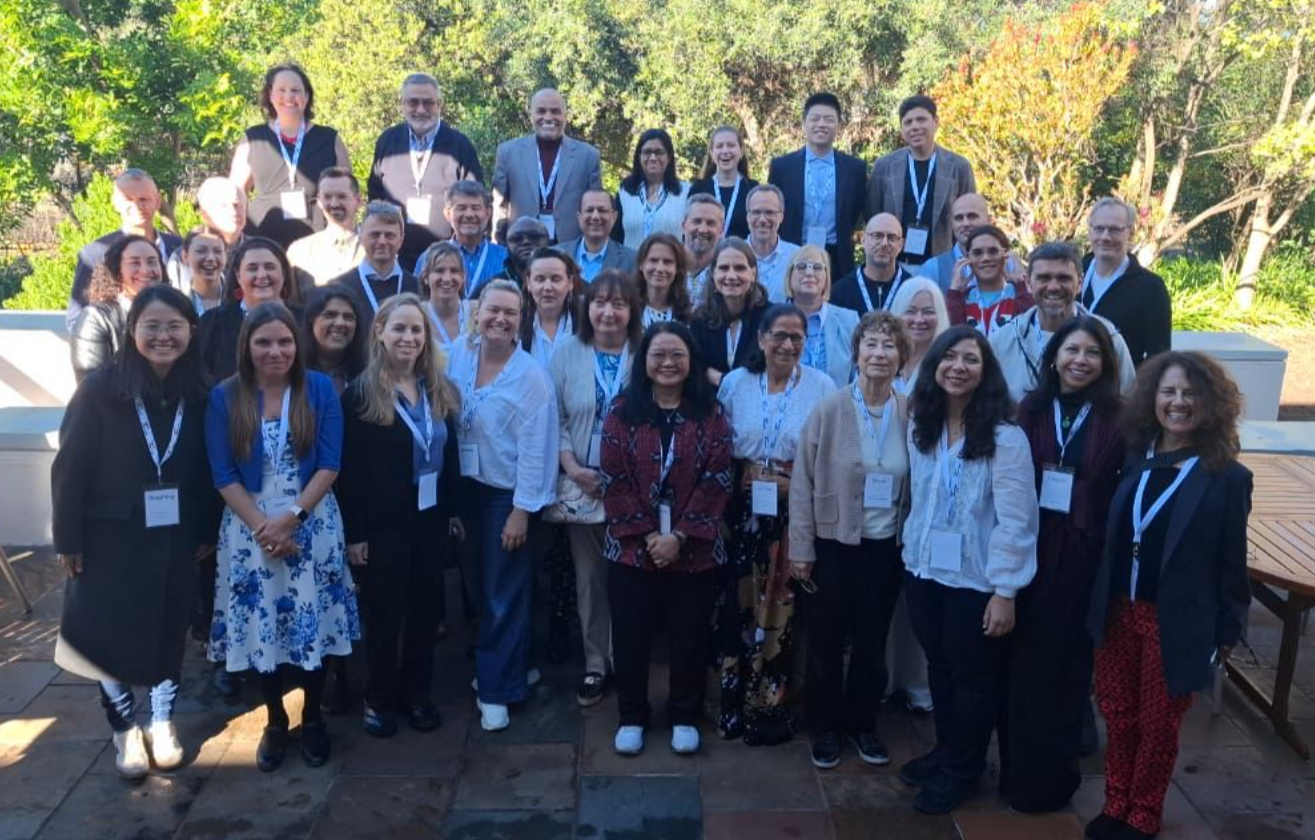
The meeting in Stellenbosch was especially meaningful because it allowed these ideas to be discussed collectively with colleagues from the WJS consortium. It was an opportunity to move from critique to operational design, from epistemological diagnosis to methodological infrastructure, and from definitional debate to practical decisions for WJS4.
The broader implication of this work is that comparative journalism research must become more reflexive about its conditions of knowledge production. If the journalistic field has changed, the architecture of comparison must make that change visible rather than forcing it back into inherited occupational assumptions.

 MARTÍN OLLER ALONSO
Deja un comentario