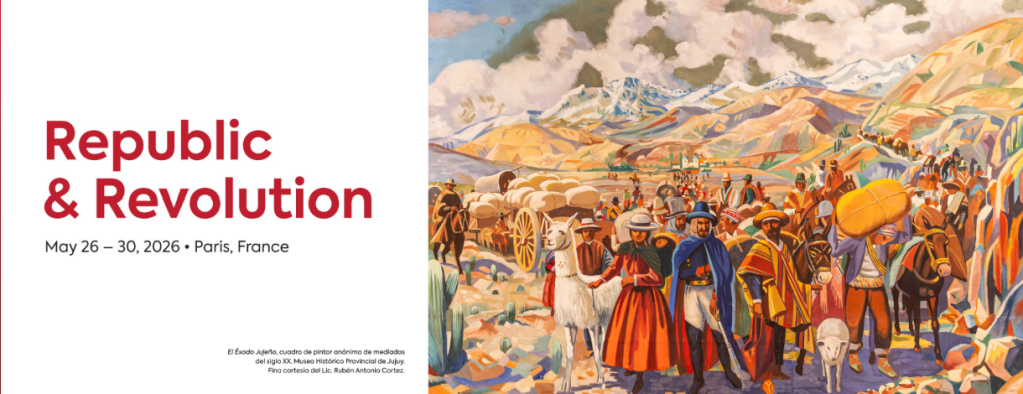
In May 2026, I participated in the LASA2026 Congress, organised by the Latin American Studies Association and held in Paris under the theme “Republic and Revolution.” The congress offered a particularly relevant framework for discussing the democratic tensions, symbolic conflicts, and communicative transformations currently affecting Latin America and the Caribbean.
Within this framework, I presented the paper “Silencing Through Shame: Determinants of Public Discredit in Latin American Journalism” as part of the panel “Challenges to Press Freedom and the Safety of Journalists in Latin America.” The session took place on Wednesday, from 1:45 p.m. to 3:15 p.m., at the Paris Marriott Rive Gauche, Studio H.
The panel was organised and chaired by Mireya Márquez Ramírez from Universidad Iberoamericana Ciudad de México, with Celia Del Palacio from Universidad de Guadalajara as discussant. It brought together several papers addressing different dimensions of press freedom, journalistic safety, self-censorship, emotional well-being, organisational pressure, and anti-press hostility in Latin America.
The panel included the following presentations:
“Silencing Through Shame: Determinants of Public Discredit in Latin American Journalism”, by Grisel Salazar, Universidad Iberoamericana; Martín Oller Alonso, Universidad de Salamanca; and Mariana De Maio, Lehigh University.
“Profiling the ‘Silenced Voices’ in the Newsroom: Factors Associated with Self-Censorship Among Journalists in Mexico”, by Mireya Márquez Ramírez, Universidad Iberoamericana Ciudad de México.
“Journalists at Risk from Within: Organisational Pressures and Workplace Violence in Brazil”, by Janara Nicoletti, University of Siegen.
“Journalists’ Emotional Well-Being in Latin America: Identity, Role Incongruence, and Gendered Stress”, by Sallie L. Hughes, University of Miami; Celeste González de Bustamante, University of Texas at Austin; and Daniela Grassau, Pontificia Universidad Católica de Chile.

The presentation examined public discrediting as one of the most significant—and still insufficiently studied—forms of hostility toward journalism in Latin America. Rather than approaching attacks against journalists only through physical violence, censorship, imprisonment, or legal intimidation, the paper proposes understanding public discrediting as a form of symbolic coercion. Its central effect is not only to damage individual journalists but to erode their professional credibility, weaken public trust, and make anti-press hostility socially available.
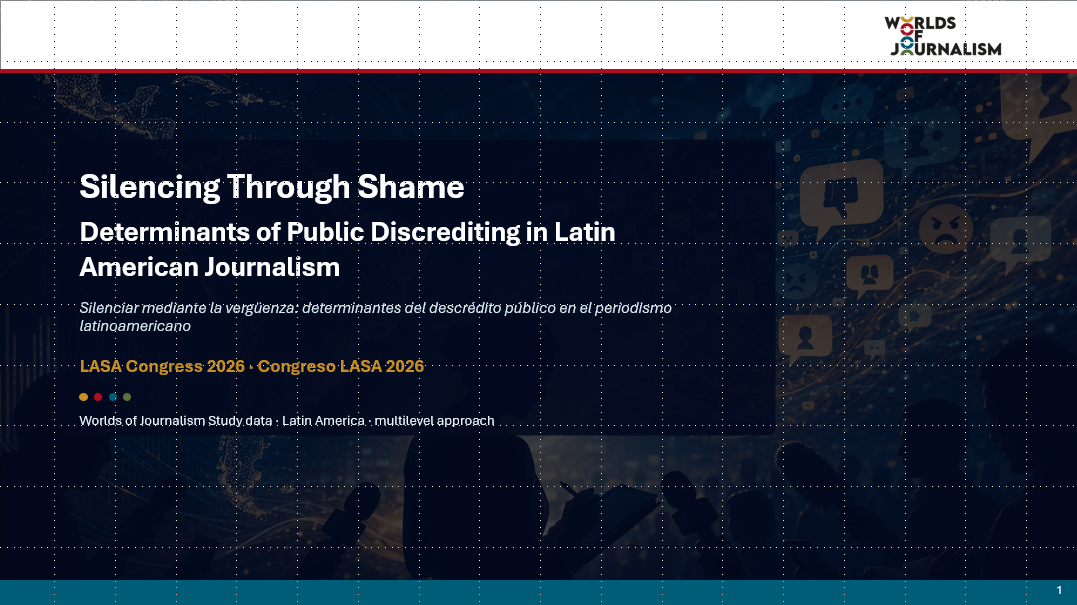
The study asks a central question: How do individual, occupational, and country-level political factors jointly determine journalists’ vulnerability to public discrediting across Latin American democracies?
To answer this question, the research draws on data from the Worlds of Journalism Study, using a sample of 5,091 journalists from 13 Latin American countries: Argentina, Bolivia, Brazil, Chile, Colombia, Costa Rica, Cuba, Ecuador, El Salvador, Mexico, Paraguay, Peru, and Venezuela. The analysis combines individual and occupational variables with contextual indicators from V-Dem, including liberal democracy, deliberative democracy, participatory democracy, political polarisation, legal protection against online defamation, and the critical orientation of the media environment.
The methodological approach is based on multilevel regression modelling, allowing the analysis to consider journalists nested within national contexts. This design makes it possible to move beyond single-cause explanations and examine how vulnerability to public discrediting emerges at the intersection of three levels:
[1] Individual level: who the journalist is.
[2] Occupational level: what role the journalist performs and in what media environment.
[3] Contextual level: where the journalist works and under what democratic conditions.
The results indicate that public discrediting is not randomly distributed. Male journalists and those who strongly embrace a watchdog role report higher exposure to public discredit. Journalists working in radio appear less exposed than those in print media, while the effect of freelance or precarious work is more limited and model-dependent. At the contextual level, liberal democracy appears to have a protective effect, while deliberative democracy, legal protection against online defamation, and more critical media environments are associated with higher levels of reported discredit.
These findings suggest that public discrediting in Latin America is not merely “noise” around journalism. It is a structured form of symbolic violence that targets credibility, professional authority, and the democratic function of the press. It does not replace physical violence against journalists, but it forms part of the same broader continuum of anti-press hostility.
One of the paper’s main contributions is the conceptual distinction between legitimate criticism and public discrediting. Legitimate criticism evaluates journalism according to professional standards, evidence, accuracy, and accountability. Public discrediting, in contrast, seeks to disqualify journalists as credible public actors by accusing them of bias, corruption, betrayal, falsehood, or political manipulation, often without substantive argument.
This distinction is especially important in Latin America, where journalism operates amid democratic instability, polarisation, populist rhetoric, fragile institutional protections, and growing digital hostility. In such contexts, public discrediting can function as a mechanism of reputational degradation, producing shame, suspicion, self-censorship, and professional vulnerability.
The broader implication is clear: any serious analysis of violence against journalists must include symbolic, discursive, and reputational forms of aggression. Public discrediting not only affects individual journalists. It reshapes the conditions under which journalism can be trusted, defended, and practised as a democratic institution.
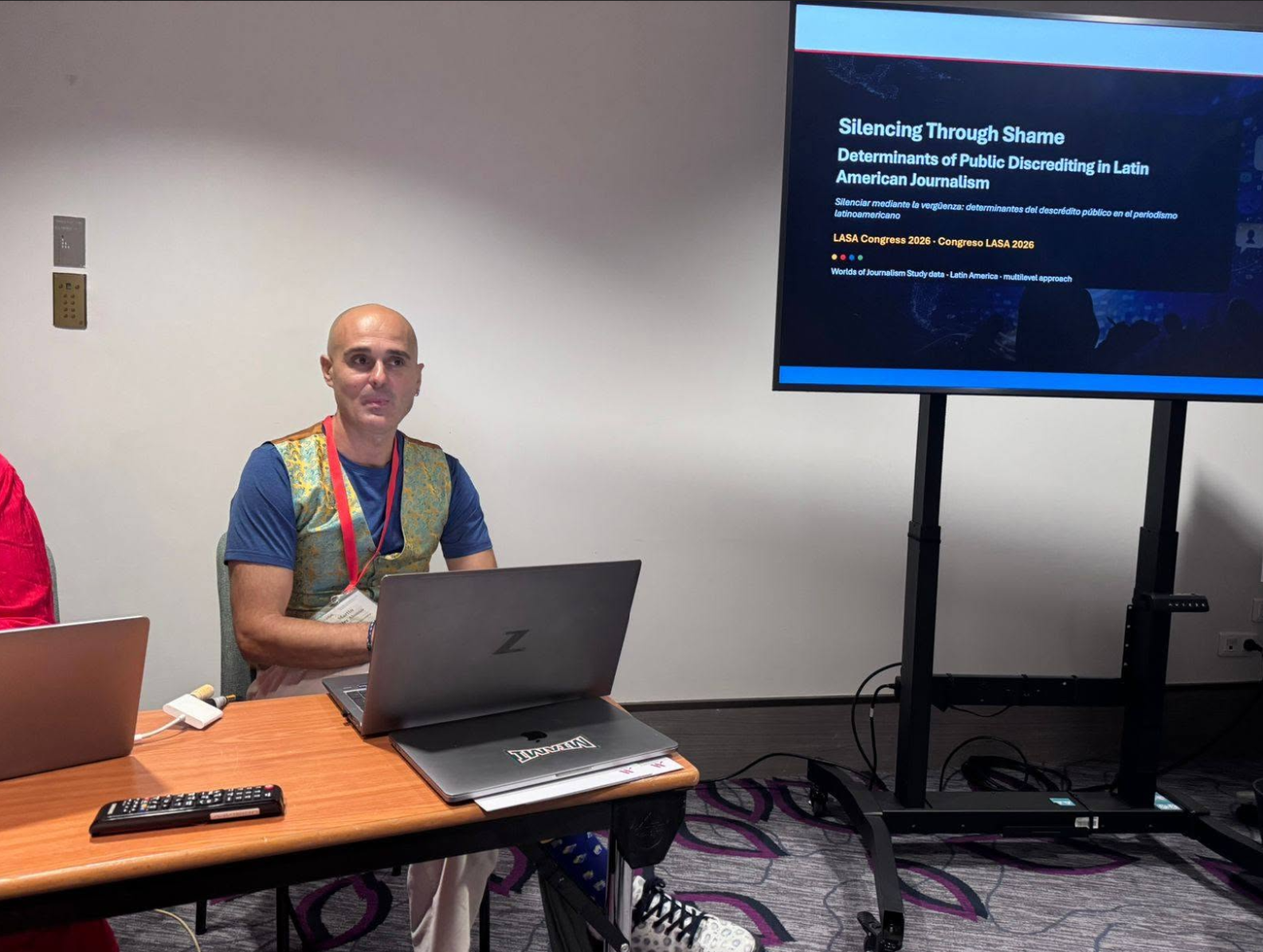
Participating in LASA2026 was an significant opportunity to connect this research with broader debates on republics, revolutions, democracy, public life, and the future of Latin America. The congress theme provided a productive intellectual space to reflect on how journalism remains central to democratic life, especially when its legitimacy is increasingly contested through both visible and subtle forms of coercion.


 MARTÍN OLLER ALONSO
Deja un comentario